
HomeHelp Advances Purpose-Built Home Management, Outlines Plans for Broader AI Integrations
HomeHelp combines home-specific guidance, maintenance planning, records and service-provider discovery—moving beyond answers toward ongoing home care.
November 14, 2026 — HomeHelp.ai is advancing its home-management platform with expanded homeowner resources, mobile tools for service providers and a roadmap for connecting its specialized capabilities with general-purpose AI assistants. Its mission is straightforward: help homeowners maintain and repair their homes with less time, less confusion and better-informed spending decisions.
Recent development has focused on bringing more of the home-care journey together: asking a question, understanding a problem, planning the next step, organizing records and finding professional help when needed.
A Dedicated Home Product—not Just Another AI Chatbot
General-purpose AI tools such as Google Gemini, ChatGPT and Claude can be valuable for research, explanations and brainstorming. HomeHelp serves a different, complementary purpose: providing a dedicated place to manage the ongoing needs of a particular home.
HomeHelp can use the property details a homeowner chooses to save—including the home’s age, location, systems and appliances—to support more relevant guidance. Maintenance tasks, project information and home records provide continuity beyond an individual conversation.
For example, a general AI assistant can explain how to maintain a water heater. HomeHelp’s approach connects that question with the homeowner’s equipment information, maintenance planning, service history and access to relevant service providers.
The distinction is not simply a different AI model. It is a home-focused product that brings information, organization and action into one ongoing workflow.
Progress Across the Home-Care Journey
Recent HomeHelp development includes:
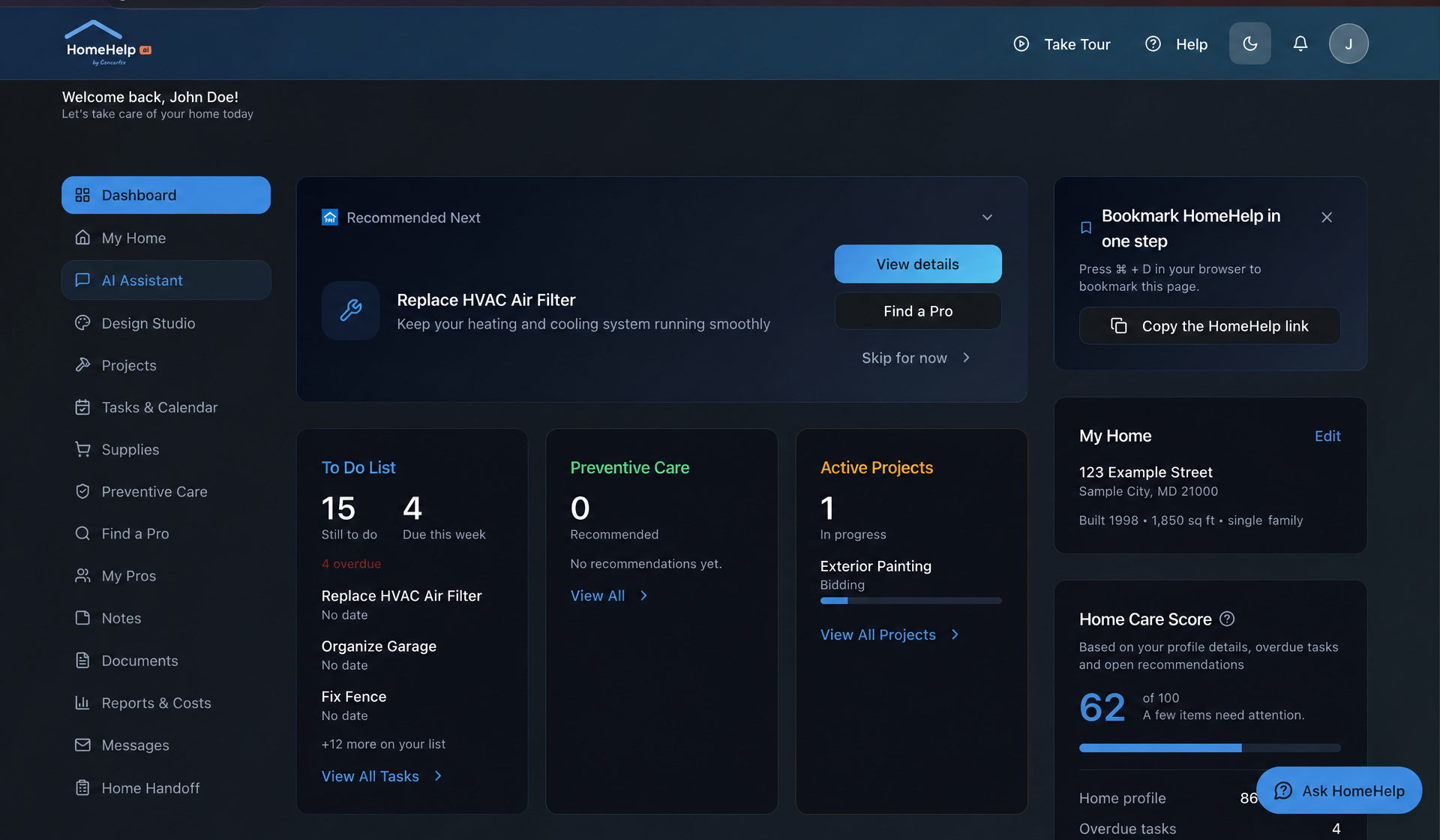
- Ask HomeHelp: Home-focused conversations using text, voice and photos to help users understand maintenance issues, explore project options and prepare for professional assistance.
- Home organization: Tools for maintenance planning, shared household tasks, appliance information, manuals, warranties and service records.
- Project and design resources: Project-planning guidance, illustrative cost ranges and a Design Studio Idea Book featuring before-and-after inspiration.
- Service-provider discovery: Search by service, ZIP code and distance, alongside professional profiles and verification information where available.
- Mobile tools for service providers: Estimates, job photos, agreements and invoices designed to support work from a phone or tablet.
HomeHelp serves homeowners across the United States, while its early service-provider rollout focuses on Maryland and surrounding states. Provider availability varies by location.
Planned Connections with the Wider AI Ecosystem
HomeHelp’s roadmap includes exploring integrations with Google Gemini, Google Search, ChatGPT and Claude. The goal is to let homeowners use familiar AI tools while maintaining a dedicated home-management account for records, tasks and follow-through.
Proposed capabilities include retrieving authorized home information, adding maintenance tasks and moving from a conversation into a relevant HomeHelp workflow. Planned connections would be designed around user-controlled access and explicit approval before outreach or other consequential actions.
These integrations are planned—not announced as available. Launch timing and capabilities will depend on development, platform requirements and any necessary approvals. No partnership or endorsement by the named platforms is implied.
HomeHelp is also developing pilot concepts for real-estate teams to help turn inspection findings, seller knowledge and home documents into a more useful buyer handoff and personalized home-care plan.
About HomeHelp
HomeHelp.ai is a purpose-built home-management platform connecting AI-assisted guidance with maintenance organization, home records, project planning and service-provider discovery. Its focus is helping people move from “What should I do?” to better-organized, ongoing care for their homes.